top of page


25 November 2025, 16:57
I was in Paris, helping Lucie and Astrid set up their new exhibition.
We left the gallery in the evening. I checked my email and saw that Movement Song was selected for IFFR 2026. Lucie and Astrid gave me hugs, we celebrated the good news.
Days leading up to IFFR 2026

November 3, 2025
A drive from Ordu to Ankara, with a delicious stop at Çakallı Mutlu Menemen


December 2025
Times at Jules' in Amsterdam. Reading on their couch.
On the NS train.
At home with flowers.


NYE at Nihan's in Amsterdam with all our cooking and Ceren's cocktails.
IFFR 2026 Opening Party


January 30, 2026, 19:00
IFFR Premiere of Movement Song
LantarenVenster, Rotterdam

Photo by Aniek van den Oever


Preparations for the screening and the guests arriving


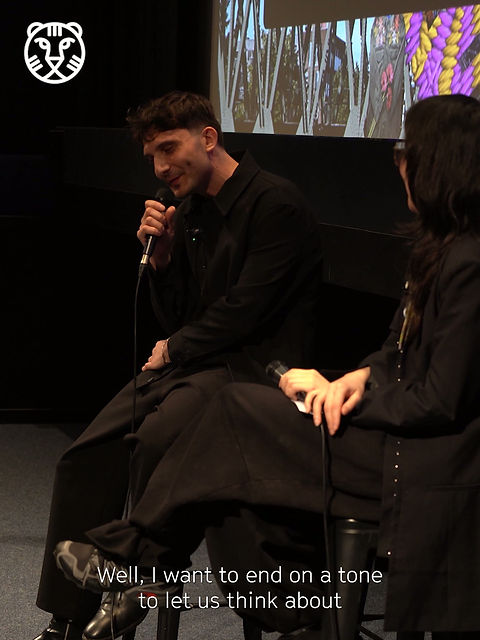
Q&A Session with the curator Hasret Emine




After the screening with Jill and her daughters Leonore and Natalie.
My flowers, and the banana cake Jill made and brought for me from France.


I love you Jill. Thank you for everything.

February 5, 2026, 15:45, Podium Islemunda, Rotterdam
Second IFFR Screening of Movement Song
Q&A Moderated by Sophie Bates


Rest of the IFFR days with friends, parties, and screenings


February 10, 2026
Interview with Jaehyun Jung for the Korean cinema magazine Cine21's IFFR 2026 special

The Overlap of Life and Film
Movement Song
Directed by Mayıs Rukel
Rotterdam - Jung Jaehyun
Mayıs Rukel, originally from Türkiye, is an artist based in Rotterdam. His feature-length debut, Movement Song, first presented in Rotterdam, is a “literary” (fictional) documentary—closely mirroring his wide-ranging artistic practice across multimedia performance, storytelling, and choreography. Here, “literary” needs to be understood in two strands.
First, Movement Song opens with a quote by the poet Audre Lorde: “Poetry is not a luxury. It is a vital necessity of our existence.” This aphorism both praises literature and serves as a declaration that summarizes the film’s own textual orientation. Throughout its runtime, the film reconstructs, in first-person voice-over narration, countless sentences and poetic lines written on “political and ethical foundations,” by many writers. And Movement Song folds the fictionality that literature gathers into the grammar of documentary.
In 2022, after a major heartbreak, Rukel traveled to the south of France in grief, tracing the traces of James Baldwin. There, as if by fate, he met Jill Hutchinson—the last lover of Baldwin’s brother, David Baldwin. The literary legacy of James Baldwin, cared for by Hutchinson, gave Rukel the momentum to move forward. “bell hooks said in Theory as Liberatory Practice that ‘academic theory healed me,’” Rukel said. “It was the same for me. Following the pain, intuition, and sorrow that loss brings, James Baldwin’s archiving felt similar. The legacy he left tied a new thread between my body and my life. Archiving stirred an ‘erotic’ impulse toward living.” In this way, Rukel made Movement Song while asking what it means that literary inheritances—archiving by masters—can influence human life not as dead text, but as a pulsing living organism.
Rukel’s experience is reenacted in the film by the woman artist Victoria McKenzie. That premise already layers fiction onto the film; and it goes a step further, asking McKenzie to perform a fictional character named Noa. Noa closely resembles McKenzie’s work and private life, and as McKenzie embodies Rukel’s time and experience, the boundary between reality and fiction blurs—twofold, threefold. Still, Rukel defines Movement Song not as fiction but as documentary. For example, in the latter half of the film, Jill Hutchinson appears as herself (or performs herself). The conversations Noa has with Hutchinson about loss were reconstructed upon the breakup experiences that Hutchinson, McKenzie, and Rukel each lived through.
“I wanted to break down the boundary between fiction and documentary. I integrated my documentary into Noa’s life—and conversely, dissolved Noa’s life into real conversations with Hutchinson—fusing multiple dimensions inside and outside the camera into a single universe. This overlap of life and film may look, to some, excessively personal and specific. But isn’t there the famous third-wave feminist line: ‘the personal is political’? The more personal and honest a story is—and the more it reveals vulnerability in its rawest form—the more it can reach the universal.”
bottom of page