top of page


Video by Adina Sharma

Quixote's Cove
February 19, 2026
Kathmandu, Nepal

In collaboration with Taragaon Next, Sattya Collective, and Quixote's Cove;
Mayıs, Nirdishtha, Adina, Susmita, Amshad, Upendra, Diwakar, Abish, Krishna, and Prasamsha
gathered to discuss:
Poetry is not a Luxury, Audre Lorde
Movement Song, Audre Lorde
Uses of the Erotic: The Erotic as Power, Audre Lorde
Giovanni's Room: Chapter I, James Baldwin
Poetry is not a Luxury (1985), Audre Lorde
Nirdishtha reflects on women's historically undervalued labour in cultural production through an anti-colonial framework.

Abish and Mayıs talk about the suppression of intuition, and how Audre Lorde's expression of "It feels right to me." can be a tool to use in daring to take decisions against societal expectations.

Susmita, Mayıs, and Adina reflect on the hierarchy between logic/reasoning and emotions. If we start feeling, then we have the ability to put our voices against oppression. Susmita and Adina share how their law studies encourage the suppression of emotions. Mayıs shares an experience with the literary critique framework the death of the author. Adina shares: Justice must be felt, and not served.

Nirdishtha argues for the logical relevance of emotions. Mayıs shares his experience with grief and his lungs. Nirdishtha reflects on the harm patriarchy and colonial mentality bring to men.

Adina asks what it truly means to be rational, and argues against the standardization of logic. Mayıs highlights Audre Lorde's arguments about the creation of a new rationality.


Upendra asks: How much of our intuition is ours versus inherited? Nirdishtha suggests that not all inherited intuition is bad for us.

Prasamsha talks about how not having the time and energy to turn thought into action might suggest that perhaps some of this is a luxury. Upendra reflects on the difficulty of making a living through art. Working to survive versus being able to create for the society/humanity. Mayıs brings the question of What is your reason to create? Transcending an individual human life, and turning your life into an offering. Krishna asks for suggestions on making it work. Adina shares about the joys of doing a work she loves.

Movement Song (1973), Audre Lorde
Mayıs reads the Audre Lorde poem Movement Song.

Mayıs reflects on Movement Song. Separation despite love. Remaining in a dignified connection. How the poem became integral to his film Movement Song. The cinematic transformation of grief in the poem.

Adina reminds how heartbreak brings out the core artist within us. Nirdishtha reflects on the poem's insistence on nuance at the point of separation. How do I remain as myself in your memory? Why does it matter how you are remembered? What difference does being young and dumb in early relationships make?


Mayıs talks about the impact of the first big heartbreak in one's life. Deepening capacity to feel with time and age; how life experience brings access to certain emotions. Transformative power of heartbreak. Upendra talks about how heartbreak cannot be created for its benefits. It appears by itself.

Susmita opens up a political reading of the poem; on the alienation of love and the relationship experiences based on class circumstances. Mayıs and Adina reflect on how love becomes resistance. Love is an action and a practice.

Adina shares a poem she wrote about grief and separation.

Uses of the Erotic: The Erotic as Power (1978), Audre Lorde
Mayıs talks about Audre Lorde's definition of the erotic. A sense of aliveness in the body. Motivation to take action, to feel, to live connectedly. Cultivating a yes and no as powerful tools within our bodies.

Adina reflects on how the meaning of erotic has been distorted. Erotic can be very simple. Feeling satisfied, a feeling of belonging can be very erotic. Mayıs connects Adina's reflections to adrienne maree brown's text Pleasure Activism.

Mayıs differentiates erotic and pornographic. Pornographic: Feeling nothing about what you consume. Agency and reciprocity is out of the equation. Extraction and abuse comes in. Erotic is a reciprocal relationship. Adina highlights: "Use without consent of the used is abuse."


Giovanni's Room (1956), James Baldwin
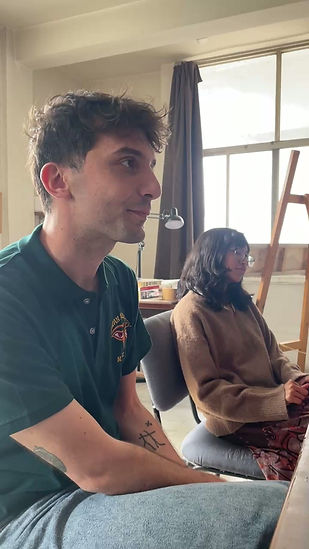
Mayıs discusses Baldwin's mastery in depicting beautiful connection and joy in intimacy. And how it is positioned against internalized homophobia and societal oppression. Repercussions of denying a big part of oneself. He also talks about Baldwin's time in Turkey and his move to southern France. He discusses how his film Movement Song holds this legacy.

Diwakar asks Mayıs why he felt that he would be the artist to tell this story.


Gratitude to Nirdishtha and Adina for organising and hosting this beautiful gathering, and to participants for the genius and generosity they brought to our table.

Participant Reflections
Adina:
As a co-organizer of the reading session with Mayis Rukel, I gave my hundred percent to create a space where literature and love could flourish. What was initially planned as a two-hour session naturally extended into four, as we found ourselves immersed in conversations about the essential things we often overlook and we cherished every moment of it. The first two hours were filled with young minds, their eyes brimming with curiosity. By the end of the session, those same eyes reflected a clarity and deep sense of fulfillment. I was one of those youths too.
Beyond facilitating, Mayis had a way of gathering the scattered sparks within me and gently placing them into one corner, making sense of them. I’ve found myself speaking about him to many of my friends, about how beautiful a person he is. A rare talent, and truly a gift to this world. Wishing you all the very best and so much love, May!
Susmita:
I hope you really enjoyed your stay here in our beautiful homeland. I'd like to thank you for visiting our country not just for the scenic beauty, which is enough reason by the way, but for the purpose that drove you here. Sharing is often a herculean task but also a selfless reflection of being human. I believe sharing your story, your piece of art with us really added flavour to your visit here. So, appreciate your courage, I'm honestly proud of you.
The reading session you hosted at Quixote Coves was beautiful and thought provoking. Before your session I was completely unaware about the brilliant work of Audre Lorde and James Baldwin, now I can't thank you enough for choosing their literature for the session.
Poetry is often seen as a luxury. Luxury by meaning is optional or not essential. However, poetry is a vital necessity of our existence which makes the use of word luxury with poetry irrelevant. Poetry helps us understand our deepest feelings, feelings help us understand our oppression. When we understand oppression, we can imagine change. This is the reason why poetry is not a decoration it is a weapon of survival.
I personally loved this discussion because this was my eye opening moment or to be a bit dramatic, I had literal goosebumps once the reality hit me. Our society is no different today too, we are still taught to distrust our feelings, suppress our desires, be quiet, be obedient, be logical instead of getting in touch with your emotion, serve others instead of listening to your inner voices because if we ever learn to break the silence then we question, we question ourselves, we let our anger work at best of its ability, we challenge the system of patriarchy and we refuse to be oppressed. This is what they fear the most. It's high time we realize that the system spares no gender including men. Therefore, poetry is power, poetry is political, poetry is a tool of resistance, poetry is survival.
During, the reading session of 'Giovanni's Room by Baldwin I love the part where David encounters his first dilemma surrounding his sexuality. I found it deeply moving. When David and Joey had their first night together, at the time it felt natural, innocent and beautifully honest. Moreover David feels happy. But the morning changes everything. David wakes up and suddenly feels fear, shame and disgust not because that's what he experienced but because he realises what it means in society.
It's sad how society teaches boys to fear softness, how masculinity is glorified, how shame is learned and not natural and how internalised homophobia is injected.
Therefore, the experience itself was not traumatic for David but the shame was. Baldwin shows how David's silence and rejection of his identity destroys his true self and deviates from acting human.
Impact or change doesn't necessarily have to be drastic or grand because mine isn't haha. Having said so, I am trying to reflect whatever I've learnt from you, the amazing people I got to encounter in the session and the authors. I'm trying to be a good listener for myself. I am definitely working on those inner voices. Getting to know yourself has been hectic but at the same time therapeutic. As a result a week ago I made one of the biggest decisions of my career based on the theory of Lorde's ' The Erotic.' That has now become the compass to navigate my life, maybe a little. I might have thrown words here and there but honestly, the session healed something in me that was long forgotten.
Thank you Mayis for loving what you do, your resilience brought art to life. I couldn't have asked for a better facilitator than you. You're extremely comfortable and genuine with your art. You're inspirational! I was so happy leaving the room after the session. You have the most enchanting personality and I was intrigued by your ability to define feelings; words somehow behave when you command them. I'm grateful for the experience. Keep creating art! After all, Earth without art is just Eh!!! Wherever you go in this world, you'll be in my quiet prayers! And also, I love your photography, you notice things and potray it in your stories with so much grace. I enjoyed seeing Kathmandu through your lense! Enjoy your remaining days here and safe travels!! I wish you all the best for your future projects!


bottom of page